
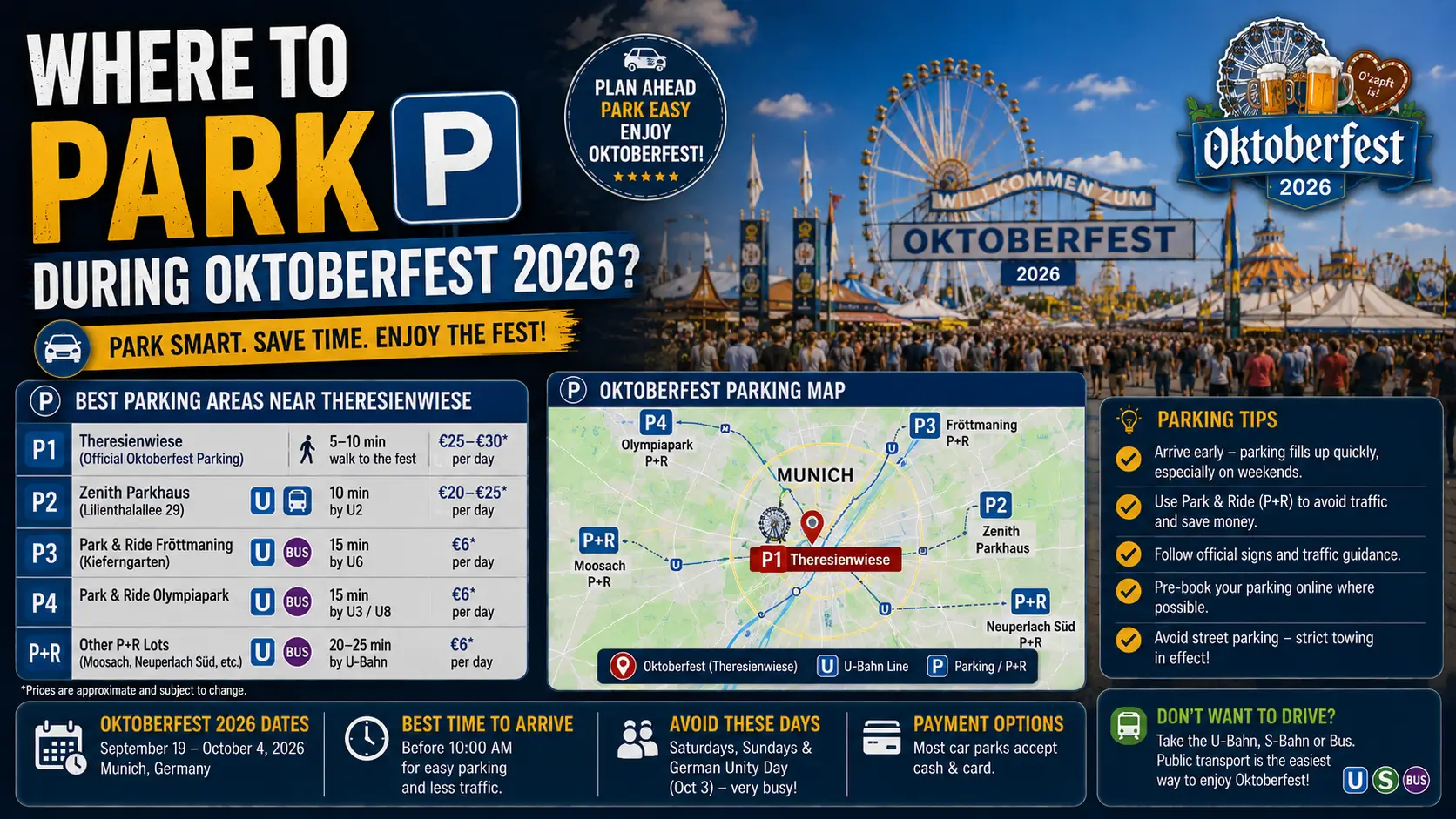
Where to Park During Oktoberfest 2026?
The honest answer to where you should park for Oktoberfest 2026 is: somewhere far away, and then take the train the rest of the way. Munich puts a hard ring of road closures around the Theresienwiese for the entire festival, nearby parking garages fill up and get rented out as long-term festival spots for up to €250 a month, and the city’s own advice is blunt about it. This guide covers exactly where the closures sit, your realistic parking options if you’re driving in from outside Munich, and why public transport wins on every metric that matters here.
Oktoberfest 2026 runs from Saturday, September 19 to Sunday, October 4. For every way to get to the grounds without a car, see our how to get to Oktoberfest guide.
Don’t drive to Theresienwiese. There is no parking at the festival grounds, a full road closure ring surrounds the area for the entire sixteen days, and even nearby parking garages are typically full or rented out long-term for the duration. Park at a Park+Ride facility on Munich’s outskirts instead, and take the U-Bahn or S-Bahn the rest of the way.
The Road Closure Ring Around Theresienwiese
For the entire duration of the festival, Munich sets up an exclusion zone around the Theresienwiese with road closures and stopping bans. The cordon is bounded by Lindwurmstraße, Herzog-Heinrich-Straße, Paul-Heyse-Straße, Schwanthalerstraße, Schießstättstraße, Heimeranstraße, Ganghoferstraße, Hans-Fischer-Straße and Poccistraße. Bavariaring and Theresienhöhe are closed to motor vehicle traffic entirely, and side streets leading into them become dead ends.
Only residents, workers, and hotel guests with addresses inside the restricted zone can get access permits. If you’re a visitor without one, driving into this area simply isn’t an option, regardless of where you’re trying to park.
Why Parking Near the Grounds Doesn’t Work
Even setting the road closures aside, the practical reality of parking near Oktoberfest is bleak. Most nearby parking garages are full for the entire duration of the festival, since many spots get snapped up as long-term rentals for the whole sixteen days, at prices reported as high as €250 a month. Munich’s own tourism site advises visitors to avoid looking for a parking spot near Theresienwiese entirely.
If you’re driving into central Munich at all, keep in mind the city’s environmental zone rules too: the entire area within the Mittlerer Ring, including the ring road itself, requires a valid green emissions sticker, and older diesel vehicles are banned outright regardless of the festival.
Your Real Option: Park+Ride
If you’re driving in from outside Munich, the sensible approach is parking at a Park+Ride (P+R) facility on the city’s outskirts and finishing the journey by U-Bahn or S-Bahn. Munich has one of Germany’s most extensive Park+Ride networks, with dozens of facilities at outer S-Bahn and U-Bahn stations offering low-cost parking paired with a quick transit connection into the city.
| Park+Ride Location | Connection | Travel Time to Theresienwiese |
|---|---|---|
| Fröttmaning | U6 line | ~20-29 minutes to Goetheplatz |
| Feldkirchen-West | U2, change to U5 at Innsbrucker Ring | ~29 minutes |
| Feldkirchen-Ost | S2 to Hackerbrücke | ~24 minutes |
| Unterhaching-Ost | U5 from Neuperlach Süd | ~19 minutes |
| München-Fürstenried | U3 from Fürstenried West | ~14 minutes |
| Hofoldinger Forst | S3 to Hackerbrücke | ~35 minutes |
Most Park+Ride facilities charge a few euros for the day, and it’s worth knowing that many of these lots accept coins only, no bills or cards, so bring some change before you set off. A parking area has also been available at Ostbahnhof since 2024, for cars and motorhomes, a short walk from the station with a direct U4/U5 connection to Theresienwiese.
Bus and Motorhome Parking
If you’re arriving by coach or motorhome, note that the exclusion zone applies to buses too, coaches cannot drive to Theresienwiese directly and must use designated parking areas outside the ring. Munich provides dedicated bus and motorhome parking areas with public transport connections into the festival, including a large facility near Messestadt Ost with a roughly 20-minute journey to the grounds via S-Bahn or U-Bahn, and a dedicated Oktoberfest camping site closer to the city with about a 10-minute transit connection.
Why Public Transport Wins Anyway
Even with a Park+Ride plan in hand, it’s worth asking whether driving into Munich at all makes sense for this specific trip. A few reasons public transport is consistently the better call during Oktoberfest specifically:
- You’re going to be drinking. Driving after visiting a beer tent isn’t an option, so a parked car becomes something you have to plan a separate trip to retrieve, rather than a convenience.
- The S-Bahn and U-Bahn run more often during the festival. Extra trains and extended late-night service mean transit is genuinely more convenient during Oktoberfest than on a normal day, not less.
- Traffic gets considerably worse. Munich’s roads see heavier congestion throughout the festival, which erodes any time a car might otherwise save you.
- Parking fees add up fast. Between Park+Ride costs, the risk of a full garage forcing you further out, and the near-total absence of options close to the grounds, a car adds cost without adding convenience.
If you’re staying somewhere in Munich for the whole trip and don’t need a car for anything outside the festival itself, it’s genuinely worth leaving the car at home, or if you’re flying in, skipping the rental altogether. For every alternative route into the grounds, see our how to get to Oktoberfest guide, which covers the U-Bahn, S-Bahn, tram, and walking routes in full.
Taxis: A Middle Ground
If you want door-to-door convenience without driving yourself, a taxi is a reasonable middle ground, though not a cheap one during the festival. Taxis are readily available and often wait near the festival exits, but catching one right after a tent closes for the night is much harder, since demand spikes all at once. Booking a cab in advance by phone or app is the safer bet if you know you’ll want one at a specific time, and fixed prices can be agreed in advance when booking this way rather than relying on the meter.
Cycling: An Underrated Option
If you’re staying within a few kilometers of the grounds, cycling is a genuinely pleasant way to get to Oktoberfest, especially during the morning and early afternoon before the crowds and beer catch up with everyone. Munich is a bike-friendly city with dedicated paths leading into the festival area. Just plan on walking or using transit for the ride home if you’ve been drinking.
Quick Reference: Should You Drive?
| Your Situation | Recommendation |
|---|---|
| Staying in central Munich for the whole trip | Skip the car entirely, use public transport |
| Day-tripping in from another Bavarian town | Park+Ride on the outskirts, then U-Bahn/S-Bahn in |
| Arriving by coach or motorhome | Use designated bus/motorhome parking outside the ring |
| Planning to drink at the festival | Don’t drive at all; use transit or a pre-booked taxi |
For a full look at what your trip costs beyond transport, see our Oktoberfest cost guide, and for where to stay within easy walking or transit reach of the grounds, our best hotels near Oktoberfest guide.
FAQ’s
No. There is no parking at the Theresienwiese itself, and a full road closure ring surrounds the festival grounds for the entire sixteen days, blocking vehicle access to the area.
Use a Park+Ride facility on Munich’s outskirts, such as Fröttmaning, Feldkirchen-West, or München-Fürstenried, then take the U-Bahn or S-Bahn the rest of the way into the city.
No. The exclusion zone around the festival applies to coaches as well. Buses must use designated parking areas outside the ring and connect via public transport.
Yes, generally. Munich’s environmental zone within the Mittlerer Ring, which includes the area around the festival, requires a valid green emissions sticker, and older diesel vehicles are banned regardless of the festival.
You’ll likely be drinking, which rules out driving home, and public transport runs more frequently during the festival while traffic gets considerably worse, so a car adds cost and hassle without adding convenience.


